

Nearly 44% of U.S. homes listed for sale in 2025 carried homeowners association dues. The listing price leaves out a bill that can follow the owner for decades.
According to Realtor.com’s 2025 HOA report, 43.6% of listings disclosed a positive monthly HOA fee. The median among those listings was $135. Both belong in a buyer’s budget.
HOA Fees Are Becoming More Common, and More Expensive
The share of listings reporting dues climbed from 34.3% in 2019 to 41.9% in 2024 and 43.6% in 2025. Over that six-year period, median monthly dues rose from $108 to $135, an increase of 25%.
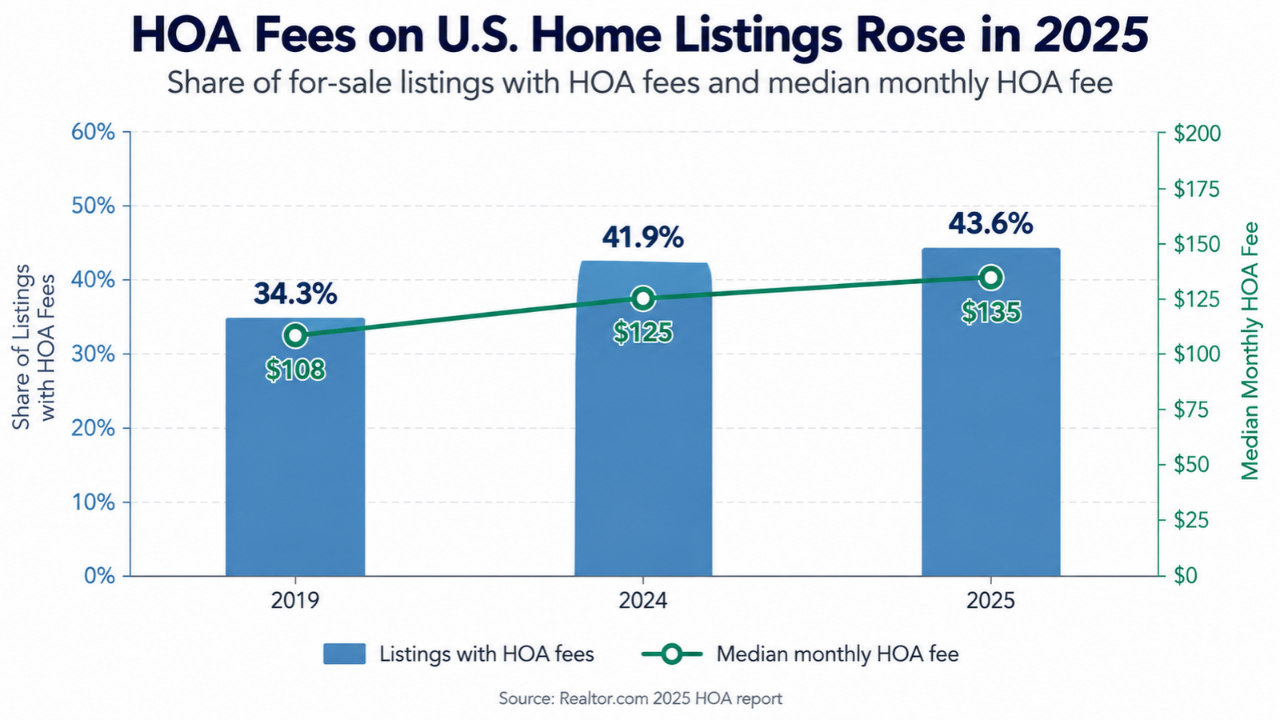
These figures come from weekly snapshots of properties advertised on Realtor.com. A listing counted when it disclosed a monthly HOA charge above zero. Listings without a reported positive charge were excluded from the fee median.
That methodology matters. The 43.6% figure describes the listings sampled during 2025. It cannot establish the share of all U.S. homes governed by associations. Likewise, $135 is the median disclosed charge among listings with dues, not a national bill for every HOA resident.
The trend deserves scrutiny.
The New-Construction Boom Is Changing the Resale Market

The spread of HOAs is closely tied to what builders put on the market. In 2025, 67.9% of new-construction listings carried dues, along with 38.9% of existing-home listings.
Association fees also appeared on 84.8% of condo and townhome listings and 33.4% of single-family listings. Detached houses increasingly carry these obligations.
As Scotsman Guide reported, HOA-heavy construction from earlier years is entering the resale supply. Those obligations generally transfer with the property when a house changes hands.
Our concern is the shrinking practical choice for buyers. In some developments, paying association dues is simply part of acquiring a relatively new house. Buyers should compare these obligations early.
A $135 Fee Is Really a $1,620 Annual Commitment
At $135 a month, the annual outlay is $1,620. Keep that charge unchanged for ten years and the cumulative payment reaches $16,200. That projection excludes increases and special assessments.
A $250 monthly fee takes $3,000 each year. At $400, the yearly charge is $4,800; at $600, it reaches $7,200. These are illustrations.
The Consumer Financial Protection Bureau explains that association dues are generally paid directly to the HOA, separately from the mortgage servicer. Fannie Mae’s housing expense requirements include association dues and special assessments when applicable to mortgage qualification.
Buyers should test the full payment against living expenses and future increases. A cheap-looking listing with large dues can become a costly mistake.
HOA Dues Aren’t Automatically Wasted Money
An HOA may pay for landscaping, private roads, shared insurance, elevators, snow removal, security, or recreational facilities. In condos, shared maintenance can be essential.
Buyers should request a breakdown of the services covered by their dues. Ask whether last year’s reported dues match the current approved budget. A short explanation of HOA fees can introduce the basics, although the association’s own documents should settle what owners actually receive.
Our strongest warning concerns associations that advertise low dues while neglecting reserves. Attractive grounds reveal little about money saved for roof replacement, structural work, or major mechanical systems. Underfunded maintenance can return as a large special assessment.
Owners also need savings for expenses inside their homes. A survey on maintenance budgeting found that 18% of homeowners reported having no maintenance budget. HOA membership offers no blanket protection against that risk.
Where You Buy Makes an Enormous Difference
Geography changes the odds of finding a home with dues. Nevada led in 2025, with HOA charges reported on 68.3% of listings, while South Dakota recorded only 12.3%.
View this post on Instagram
Florida stands out for the size of certain fees. The Miami–Fort Lauderdale–West Palm Beach metro had a median reported HOA charge of $617 a month. Realtor.com measured that at 26.9% of a modeled principal-and-interest mortgage payment, assuming 10% down and a 6% mortgage rate.
That percentage excludes taxes, insurance, and the other elements of an owner’s total monthly housing expense. It should never be presented as 26.9% of the entire housing payment.
Higher insurance premiums, inspection obligations, and condominium reserve requirements have increased costs in parts of Florida, as ConsumerAffairs explained. Our analysis of rising home insurance costs shows another pressure on homeowners. Associations face their own insurance bills, which can flow through to owners.
Some Californians also face approved wildfire insurance surcharges on individual policies. These overlapping expenses deserve room in the household budget.
Do Homes With HOAs Actually Offer Better Value?
Among existing listings in 2025, properties with HOA dues had a $450,000 median asking price. Those without dues had a median of $374,900. That $75,100 difference is real in the data, although it cannot measure the value added by an association.
The groups contain substantially different houses. Existing homes with HOAs had an average construction year of 1998, compared with 1968 for those without dues. Differences in square footage, neighborhood, and condition further complicate any price comparison.
Here’s how broken the housing market is:
US newly built homes were more expensive than existing homes by only 3% on average this year.
This is the lowest premium for a new home since the early 1980s and in-line with the early-1970s.
By comparison, the average premium for a new home since 1968 has been 16%, or ~5 times higher.
This comes as existing homeowners have refrained from selling their homes, reducing supply to near record lows.
At the same time, new homes are getting smaller and less sophisticated.
You know something is wrong when new is getting cheaper than old.
— The Kobeissi Letter (@KobeissiLetter) December 5, 2024
An older discussion of new-home price premiums shows how easily headline comparisons can miss changes in the properties being sold. For HOA comparisons, the same discipline applies: examine genuinely comparable homes and include recurring fees in the ownership calculation.
We would reject any sales pitch claiming HOA membership automatically protects resale value. It takes local evidence, credible comparable sales, and a review of association finances to support that judgment.
Five Things We’d Check Before Buying
Before making an offer on an HOA property, we would demand clear answers to five questions:
- What do the dues cover? Identify shared maintenance, utilities, insurance, amenities, and costs left to the owner.
- How healthy are the reserves? Examine financial statements, budgets, reserve studies, and the condition of major shared components.
- Are assessments or increases coming? Ask about planned work, recent collections, unpaid dues, litigation, and adopted fee changes.
- Which restrictions apply? Read the governing documents for limits on renovations, rentals, parking, pets, and property use.
- Can the budget survive higher dues? Calculate affordability with insurance, taxes, repairs, and a realistic cushion for increases.
A neat entrance cannot show whether the roof is funded.
The Cost of Ownership Matters More Than the Listing Price

The 43.6% share shows how deeply HOA charges have entered the homes-for-sale market. Buyers now need to scrutinize dues as routinely as they examine property taxes and insurance premiums.
Our position is firm: never commit to an HOA property before reviewing its financial health and rules. The cheapest dues today can conceal tomorrow’s most expensive assessment. The purchase only makes sense when the complete ownership cost fits the budget.