
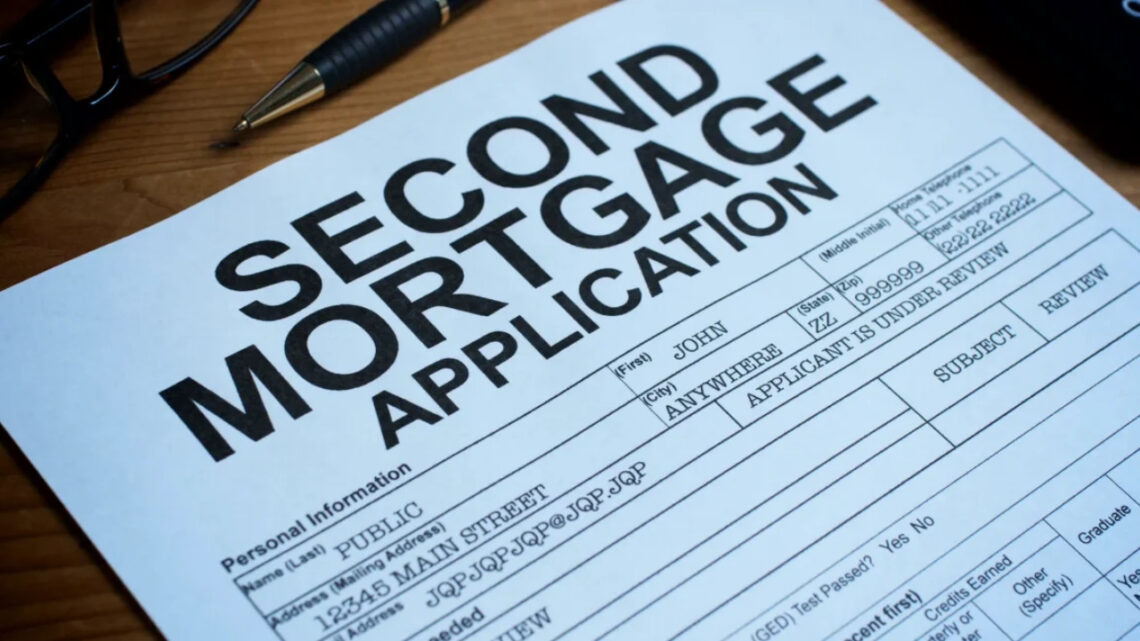
Nearly 3.9 million homeowners with primary mortgages from 2020–2022 now carry second liens, often to protect exceptionally low first-mortgage rates.
Preserving those rates makes sense. Borrowing against a house to cover unaffordable expenses carries serious risks.
3.9 Million Homeowners Have Added a Second Loan

Intercontinental Exchange (ICE) found in its June 2026 Mortgage Monitor that 3.9 million borrowers from the 2020–2022 first-mortgage cohort also had second liens. This figure applies specifically to that cohort.
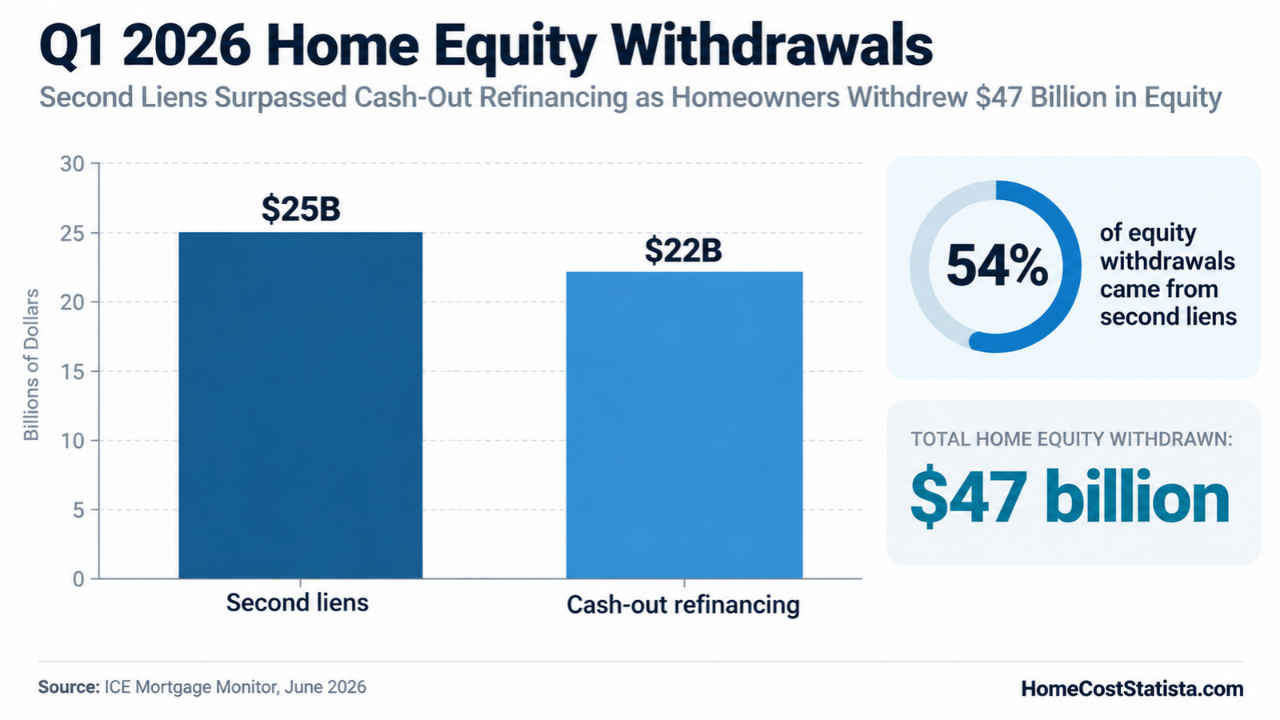
More than half of the equity withdrawn, 54%, came through second liens. Nearly two-thirds of new second-lien originations involved borrowers who obtained their primary loans during 2020–2022.
Cheap first mortgages are worth protecting. That makes second-lien offers tempting, even when the new debt strains household finances.
A second lien also creates a second claim against the property. The original mortgage payment may stay low while the total monthly housing obligation climbs.
Why Give Up a 3% Mortgage When New Rates Are Above 7%?
Some borrowers obtained 30-year rates below 3% during the pandemic. Accessing equity now requires careful comparison.
Freddie Mac’s mortgage rate archive records a 7.40% average on October 15, 2026, and 7.24% on October 29. Both tower over pandemic-era mortgage rates.
View this post on Instagram
Consider an outstanding mortgage balance of $200,000 at 3%. Replacing it with a new loan at 7.24% would raise the interest rate on the entire refinanced balance, before accounting for any additional cash borrowed and closing costs.
A second lien preserves the first mortgage while creating a separate debt with its own terms and payments.
The crucial comparison involves the amount being borrowed. A homeowner seeking $40,000 of additional cash might avoid repricing a much larger existing first-mortgage balance. Fees, loan duration and payment structure still determine the actual savings.
Two Ways to Access Home Equity
| Home equity loan | HELOC |
| Provides a lump sum | Offers a revolving credit line |
| Generally has a fixed interest rate | Usually has a variable rate |
| Scheduled principal and interest payments | Payments can change, especially after the draw period |
| Often suited to one large expense | Often suited to expenses spread over time |
Both use the home as collateral. Approval depends on income, credit and equity.
Compare the full cost of both options. A cheap first mortgage never justifies careless borrowing.
A $50,000 Second Loan Might Cost Just $275 a Month, Initially

ICE reported an average second-lien HELOC rate of 6.6% in March 2026, the lowest since late 2022. At that rate, a $50,000 outstanding balance generates $275 in monthly interest.
HELOC fees, appraisal charges and early-closure penalties can increase the overall cost beyond interest payments.
The $275 example assumes interest-only payments, constant rates and an unchanged balance.
An Illustrative $50,000 HELOC at 6.6%
- Monthly interest-only payment: $275
- Principal paid through those payments: $0
- Outstanding principal after five years: $50,000
- Total interest over five years: $16,500, assuming no rate or balance changes
After five years, the entire $50,000 remains owed. Variable rates could increase monthly payments.
The Consumer Financial Protection Bureau warns that HELOC payments can rise significantly when the draw period ends and repayment begins. Some agreements require rapid repayment.
Interest-only affordability is a dangerously weak borrowing test. Plan for principal repayment before signing.
For adjustable-rate HELOCs, request payment illustrations under higher interest rates and after the draw period. Review whether the lender can freeze future draws. A credit line is an unreliable substitute for emergency savings.
Home Equity Is Not the Same as Cash in the Bank
Home equity equals estimated property value minus secured debt. Borrowing creates another repayment obligation.
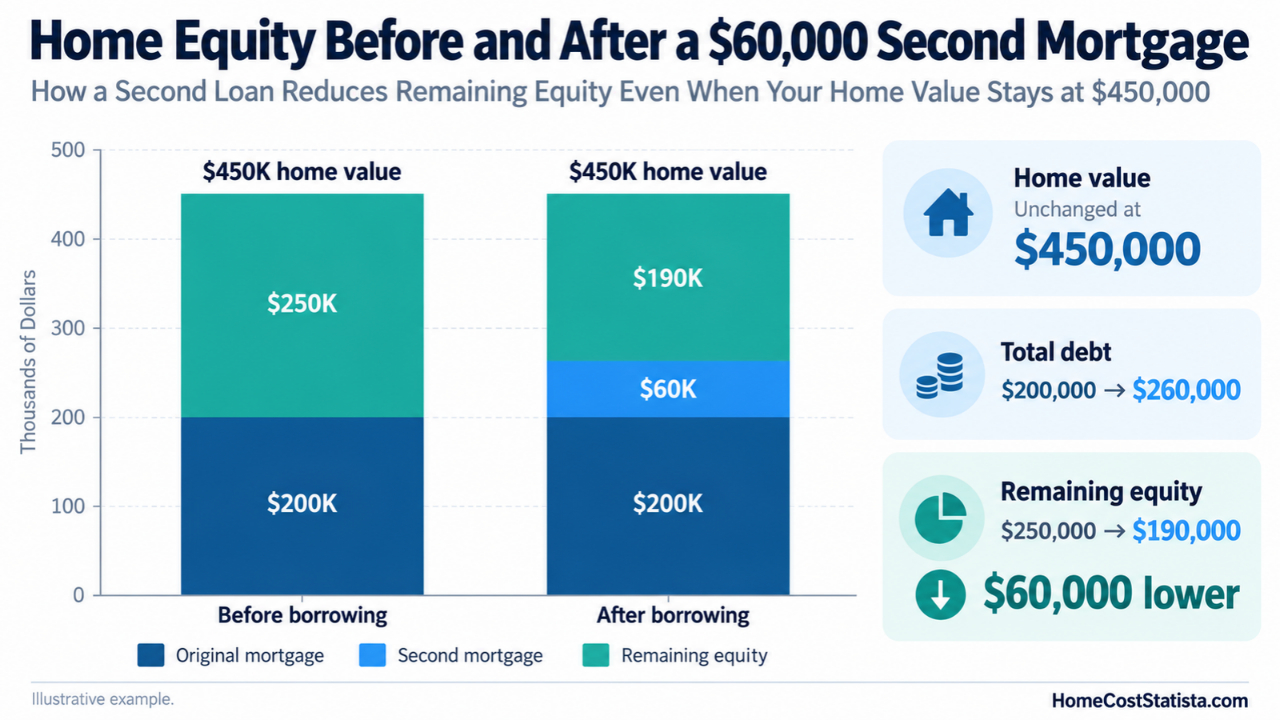
Suppose a home is valued at $450,000 and carries a $200,000 first mortgage. Its starting equity is $250,000. Borrowing another $60,000 raises combined secured debt to $260,000 and reduces remaining equity to $190,000.
Market prices can move independently of debt balances. Selling expenses can reduce the homeowner’s proceeds further.
Borrowing to repair a dangerous electrical system may be justifiable. Funding an ambitious cosmetic remodel requires tougher scrutiny. Our reporting on renovations that exceeded their budgets shows how quickly planned spending can expand.
A $60,000 renovation offers no guarantee of adding $60,000 in resale value.
The risk becomes larger when the project also overruns its budget. Contractors may uncover damage or charge for changes in scope. Homeowners should evaluate the likely property benefit before committing the house as security.
Are Homeowners Borrowing Because They Want To, or Because They Have To?
ICE does not identify how many borrowers funded repairs, renovations, debt consolidation or household bills.
Question the necessity, expected benefit and full repayment plan for every proposed use of home equity.
Other housing-cost research illustrates the pressure on budgets:
- Home insurance premiums have risen sharply, with one analysis estimating a 46% increase since 2021.
- The share of homeowners with no maintenance budget rose from 9% to 18% in the survey discussed in our reporting.
- Unexpected repairs have delayed planned projects for some homeowners.
Association dues add another obligation. In 2025, 43.6% of listed homes carried HOA fees, with a median reported monthly charge of $135 among those listings.
Different studies cannot establish individual borrowers’ motives.
They do establish a financial reality: keeping a cheap first mortgage leaves insurance, taxes, repairs and maintenance fully exposed to rising costs. A household using home equity routinely to absorb those bills may be postponing a cash-flow problem while making the eventual repayment burden heavier.
We would be especially concerned about repeat equity withdrawals. A household facing the same budget shortfall every year needs to address recurring costs directly. Additional secured borrowing can compound that underlying problem.
The Mortgage Lock-In Effect May Be Keeping Homes Off the Market
Low mortgage rates give homeowners strong incentives to remain in place. Selling forfeits that financing.
For a household considering a larger home, moving may require a substantially higher monthly payment. Someone planning to downsize could face the same problem, even after purchasing a less expensive property.
Home improvement and second-lien borrowing become attractive ways to continue living in the existing home.
Second-lien borrowing fits the mortgage lock-in pattern. ICE offers no evidence that those particular borrowers would otherwise have sold.
The concern for first-time buyers is straightforward. Existing owners holding onto their homes can reduce the number of available listings, especially where supply is already tight.
When Would I Consider a Second Mortgage Sensible?

A second mortgage deserves serious consideration when the expense is essential, the homeowner has adequate reserves, and the combined payments remain affordable under unfavorable conditions.
We would insist on answers to four questions before signing:
- What exactly will the money pay for? A clearly priced essential repair provides a stronger case than an open-ended wish list.
- What happens when principal payments begin? Calculate the repayment-period obligation and test higher variable rates.
- What happens if income or property value falls? Both mortgages remain payable even when equity contracts.
- What alternatives cost less overall? Compare savings, phased work, unsecured financing and postponement where practical.
Review combined loan-to-value, fees, refinancing restrictions and emergency reserves. Lender approval should trigger a separate, rigorous household affordability review.
Both liens expose the property to foreclosure if required payments cannot be made. That consequence needs to sit at the center of the decision.
Our Take…
@mortgageswithpower 2nd mortgages, really are a good product, but BEWARE! #mortgages #canada #debt #money #homeowner ♬ som original – 𝙇𝙚𝙤🎙𝙁𝙡𝙖𝙨𝙝𝙗𝙖𝙘𝙠🎶🎵
Keeping a 3% first mortgage can be a smart financial move. Taking a second loan against the same home can also be sensible for a necessary, affordable expense.
We draw a hard line at using home equity to sustain spending that ordinary income cannot support. An attractive starting payment provides little protection when principal comes due.
Protect the low mortgage rate. Protect the ability to repay every loan attached to the house.