
An unexpected repair can wipe out a renovation budget before the planned work even begins.
According to Angi’s 2026 homeowner research, 23% of surveyed homeowners who postponed a project cited an unplanned or emergency project as the reason. The same research found that maintenance and repairs were taking priority among homeowners who had recently hired professionals.
The repair and renovation figures tell the story: 63% reported maintenance work in the previous month, 58% completed repairs, and 35% undertook renovations.
We think homeowners consistently underestimate how much ordinary deterioration can interfere with their improvement plans. A renovation budget is only as secure as the condition of the expensive systems already inside the house.
A Repair Can Rearrange an Entire Year of Projects
Consider a homeowner who has saved $15,000 for improvements.
The plan is to replace aging flooring and make a few bathroom updates. Then the HVAC system fails, requiring a $9,000 replacement.
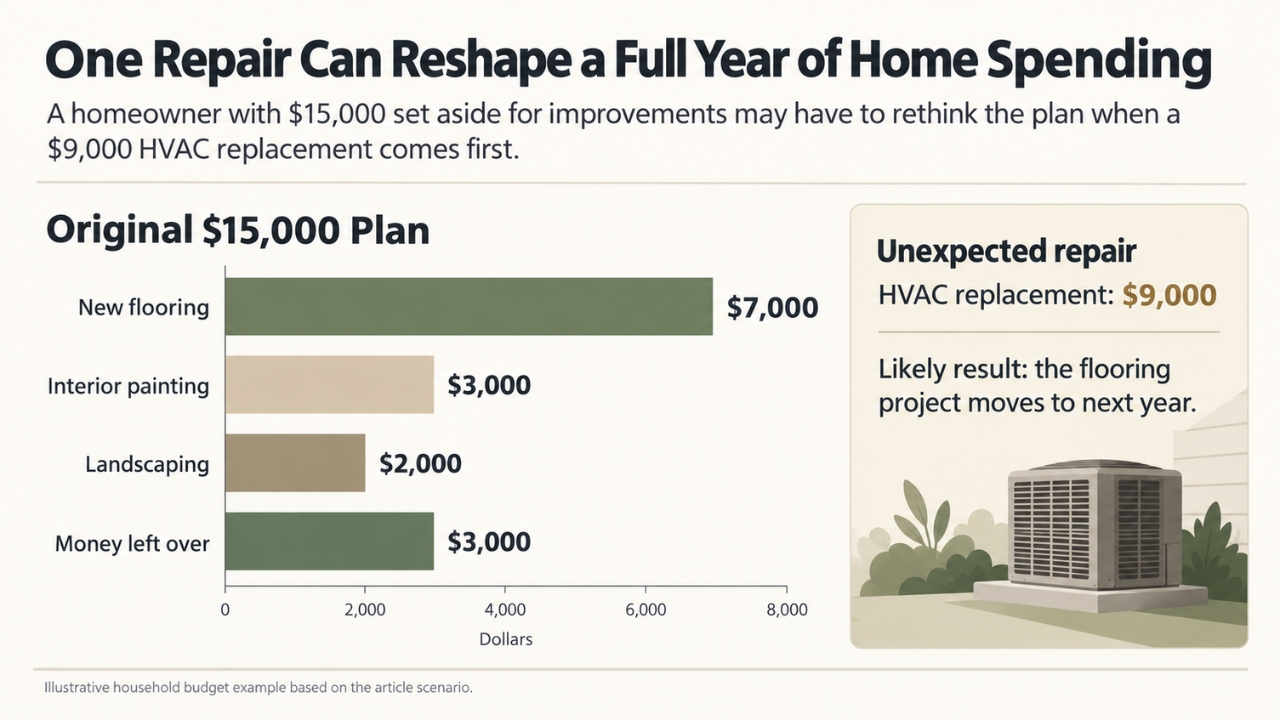
One breakdown has consumed 60% of the available money. The planned projects are now competing for the remaining $6,000.
And that assumes the HVAC replacement finishes at the quoted price.
Recent buyers face additional pressure because the first-year costs of homeownership often include furniture, appliances, and property improvements alongside unexpected repairs.
Angi found that 43% of homeowners who recently hired professionals exceeded their original budgets. Our examination of homeowners who hired professionals explains why even experienced contractors cannot eliminate every financial surprise.
Among those who exceeded their estimates, more than one-third spent at least 30% more than expected. Those renovation cost overruns can easily consume money reserved for another project.
We believe the financial impact of a repair should be evaluated across the entire household improvement plan. A $9,000 HVAC replacement has implications for flooring, bathrooms, landscaping, and every other project sharing the same savings account.
There is also a case for reconsidering the scope of certain improvements. Homeowners planning to replace flooring because of noise, for example, may benefit from investigating how to fix squeaky floors before paying for an entirely new surface.
When money becomes tight, smaller targeted repairs deserve serious consideration.
Unexpected Housing Costs Are Hardly Unusual

The frequency of major unexpected expenses raises an uncomfortable question: why do so many household budgets assume they will be rare?
The Federal Reserve’s 2025 household financial well-being report, published in May 2026, found that 59% of U.S. adults experienced at least one major unexpected expense during the previous year.
A major house or appliance repair affected 22%.
That survey covers American adults generally, including renters, so the 22% figure should not be interpreted as the proportion of homeowners experiencing repairs.
The cost distribution is particularly revealing. According to the Federal Reserve’s supplemental survey data, 26% of respondents who reported a major unexpected house or appliance repair put the expense at $5,000 or more.
That is a substantial amount of money to find without warning.
For a household saving $400 a month toward improvements, a $5,000 repair represents more than a year’s worth of contributions.
Our concern is that homeowners often treat emergency repairs as exceptional financial events while making improvement commitments that consume most of their available savings.
The specific breakdown may be impossible to predict. The eventual need to replace worn equipment is entirely foreseeable.
Our Homes Are Also Getting Older
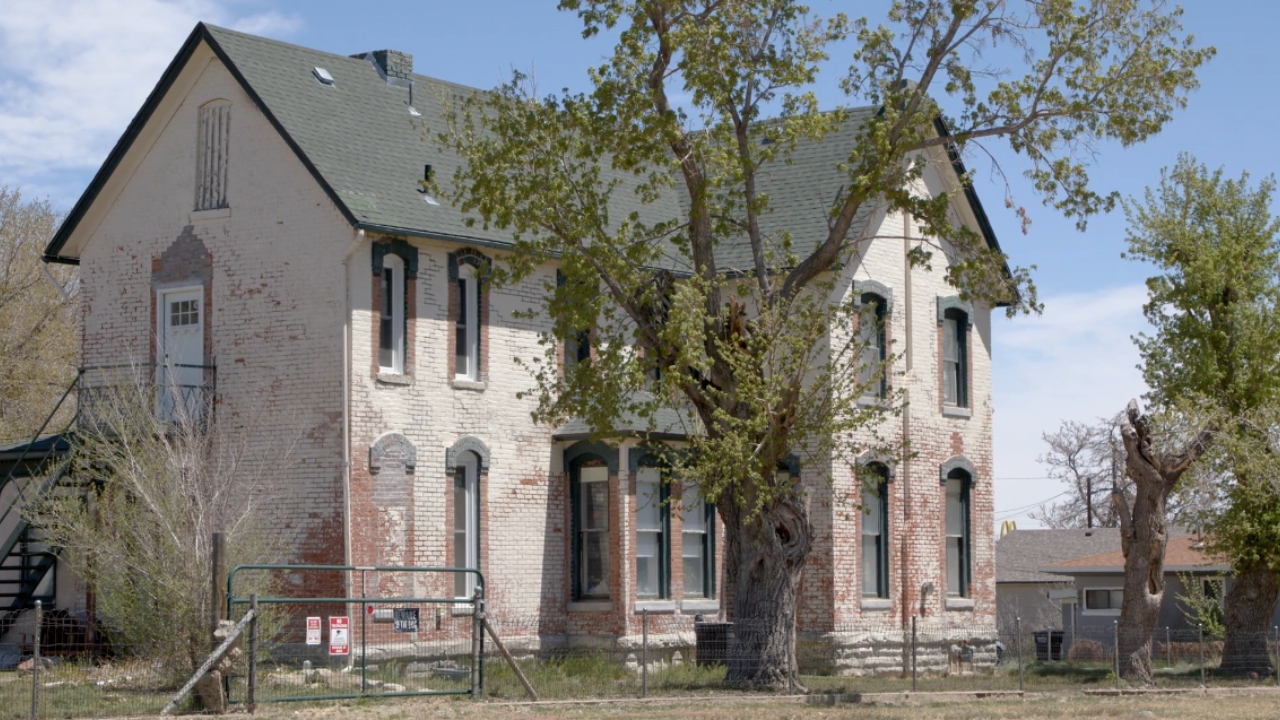
America’s aging housing stock makes the competition between repairs and renovations increasingly important.
Harvard’s Joint Center for Housing Studies reported that the median age of the U.S. housing stock reached 44 years in 2023, compared with 39 years in 2013 and 28 years in 1993.
Its analysis of America’s aging homes also shows how maintenance and replacement expenses account for a greater share of spending on older properties.
An older house may have decades of useful life remaining. Its major components still operate on individual replacement schedules.
Roof coverings deteriorate. Water heaters fail. Heating and cooling equipment wears out. Plumbing, drainage systems, windows, and exterior materials eventually demand attention.
Harvard’s remodeling industry research found that average maintenance spending in 2023 was 76% higher for homes built before 1980 than for homes constructed since 2010.
That is a major difference, although it reflects actual spending and should not be mistaken for a precise measure of repair needs.
We think the aging housing stock deserves far more attention in discussions about renovation demand. Older properties can create substantial replacement expenses, and many owners must finance those replacements from the money they had intended to spend elsewhere.
Home Age Is Only Half the Story
I would still be careful about using age alone.
The questions I would rather ask are:
- How old are the roof, furnace, air-conditioning system, water heater, windows, and major appliances?
- Has the plumbing or electrical system been modernized?
- Are there existing signs of water intrusion, foundation movement, drainage trouble, or deferred exterior maintenance?
- Which major component is most likely to require replacement during the next three to five years?
Two homes built in 1975 can have completely different financial outlooks.
One may have received $80,000 worth of major systems work during the past decade. The other may still be waiting for it.
That is why I have never been especially fond of maintenance rules based purely on a percentage of home value. They are convenient. Houses are considerably less cooperative.
Renovations Can Create Their Own Repair Bills
Sometimes the renovation itself uncovers the repair that disrupts the budget.
Houzz’s 2026 remodeling trends research found that 37% of renovating homeowners who established budgets exceeded them during 2025.
Among those who went over budget, 52% cited higher-than-expected product or service costs, 32% encountered unanticipated project complexity, and 22% reported construction-related issues.
View this post on Instagram
That final category deserves attention because so much residential deterioration remains concealed until work begins.
A bathroom remodel may expose compromised subflooring. Removing cabinets can reveal old water damage. Opening a wall can uncover electrical defects or deteriorated plumbing.
Those discoveries can introduce additional labor, materials, inspections, and delays.
The financial problem becomes especially difficult when homeowners have already committed most of their savings to finishes, fixtures, and contractor payments.
Our position is straightforward: a renovation involving demolition deserves a contingency allowance based on the likelihood and potential cost of hidden defects. Older systems, previous water damage, and uncertain renovation histories should influence that allowance.
An estimate based on visible conditions cannot settle the price of every concealed problem.
Postponing a Renovation Is Not Necessarily Bad News
We would question any interpretation that automatically treats delayed renovations as evidence of deteriorating homeowner confidence.
Project priorities matter.
Replacing a leaking roof has immediate implications for the condition of the property. Updating an unfashionable kitchen generally offers greater scheduling flexibility.
A household that chooses the roof first may be making a financially sound decision.
The Angi research reinforces this interpretation. Although homeowners are postponing some discretionary improvements, 66% of respondents still expect to make a major investment in their homes within five years.
That was the highest proportion Angi had recorded in its State of Home Spending research.
The implication for the renovation industry is important. Delayed projects can remain part of future demand, although survey intentions do not guarantee that the work will eventually happen.
For homeowners, choosing the sequence of projects carefully can preserve financial flexibility and reduce the risk of more expensive damage.
We consider that a sensible approach to property ownership.
Repair Money Should Not Be Renovation Money

One of our strongest concerns is how easily homeowners can commit their available cash to improvements while leaving major repair obligations unfunded.
The problem is becoming more visible.
Recent research found that the proportion of homeowners with no home maintenance budget doubled from 9% to 18% between 2024 and 2025.
A household with no money assigned to maintenance is exposed to the next expensive system failure.
Other ownership expenses complicate the picture. For example, the median monthly HOA fee among U.S. home listings reporting an association charge reached $135 in 2025. That represents $1,620 annually at an unchanged rate, with special assessments potentially adding further expense.
Now consider someone saving $20,000 for a kitchen renovation.
Spending the entire amount may seem reasonable while the house is functioning properly. The financial calculation changes when the roof, water heater, HVAC system, or sewer line has a realistic chance of requiring major work in the near future.
We would assess those risks before approving the renovation budget.
The 2026 Houzz renovation study found that 84% of renovating homeowners used savings to finance their projects, while 34% used credit cards.
The credit-card figure measures use as a financing source. It does not establish how much debt homeowners carried after their purchases.
Even so, the possibility of financing an emergency repair through high-interest revolving debt is a serious concern.
A higher credit-card balance may also affect home insurance premiums in states that permit credit-based insurance scores.
Financing an emergency home repair at expensive credit-card rates can strain a household budget, especially if insurance claim funds remain under the mortgage lender’s control.
Home equity borrowing can provide another source of financing. Some homeowners use a HELOC or second mortgage to access funds while preserving a low interest rate on their original mortgage.
That approach creates additional debt obligations and introduces borrowing costs that need to be weighed carefully.
We believe homeowners should separate their finances into three practical categories: routine maintenance, major repair reserves, and discretionary improvements.
The appropriate amounts depend on the property’s condition, replacement costs, household income, existing savings, and access to other funds.
A renovation that leaves the household unable to handle a foreseeable major repair deserves a smaller scope or a later start date.
Deferred Maintenance Has a Cost Too
There is a financial danger in postponing necessary work for too long.
Small defects can develop into major problems when the underlying cause remains unresolved.
A minor roof leak can damage framing, insulation, and drywall. Poor drainage can contribute to foundation and moisture problems. Failed seals around plumbing fixtures can allow water to reach materials hidden beneath floors or behind walls.
Mold adds another potential expense. Homeowners should understand insurance coverage for mold damage, particularly because coverage depends on the cause of the damage, policy terms, and exclusions.
We would prioritize any maintenance issue involving water intrusion, structural deterioration, electrical safety, or essential heating and plumbing systems.
Cosmetic work generally offers considerably more flexibility.
There is also a limit to what routine upkeep can prevent. A well-maintained appliance will eventually wear out, and a properly maintained roof still has a finite service life.
The objective is to control avoidable damage, recognize replacement needs early, and preserve enough financial flexibility to respond when major work becomes necessary.
In our view, preventive maintenance deserves the same seriousness homeowners give to major renovations. The financial consequences of ignoring it can be substantial.
The House Gets a Vote
Repair budgets are competing with other rising costs of ownership.
Recent increases in home insurance costs have added pressure to many households. Heating is another concern, with average winter home heating costs projected at $1,030 for the 2026–27 season under one industry forecast.
The Federal Reserve’s research on household financial hardships provides further evidence of the difficulty some households face when bills and unexpected expenses accumulate.
We think the central lesson is simple: homeowners should evaluate the condition and likely replacement cost of their existing systems before committing large sums to optional improvements.
A repair reserve cannot prevent a breakdown. It can prevent that breakdown from destabilizing the rest of the household budget.
The house will eventually demand money on its own schedule. A responsible renovation plan leaves room for that demand.