
The share of U.S. homeowners reporting no annual maintenance budget doubled from 9% in 2024 to 18% in 2025. That finding in Hippo’s 2026 Housepower Report deserves more attention than another headline about expensive home repairs.
A zero-dollar maintenance budget leaves the household exposed to bills that are inevitable in principle, even when their timing is uncertain. It also suggests that the cost of keeping a house functional is being pushed out of financial planning altogether.
The financial pressure can start much earlier, as expenses that follow a home purchase can consume thousands of dollars before new owners establish a repair reserve.
Our concern is that more homeowners appear to be leaving the condition of their most valuable asset dependent on whatever cash happens to be available when something breaks.
Maintenance Budgets Are Getting Smaller
Hippo’s survey shows a broader retreat from larger maintenance budgets. In 2025, 58% of homeowners reported budgeting between $500 and $4,500 for routine upkeep, compared with 39% in 2024. The share allocating $6,501 or more fell from 35% to 14% over the same period.
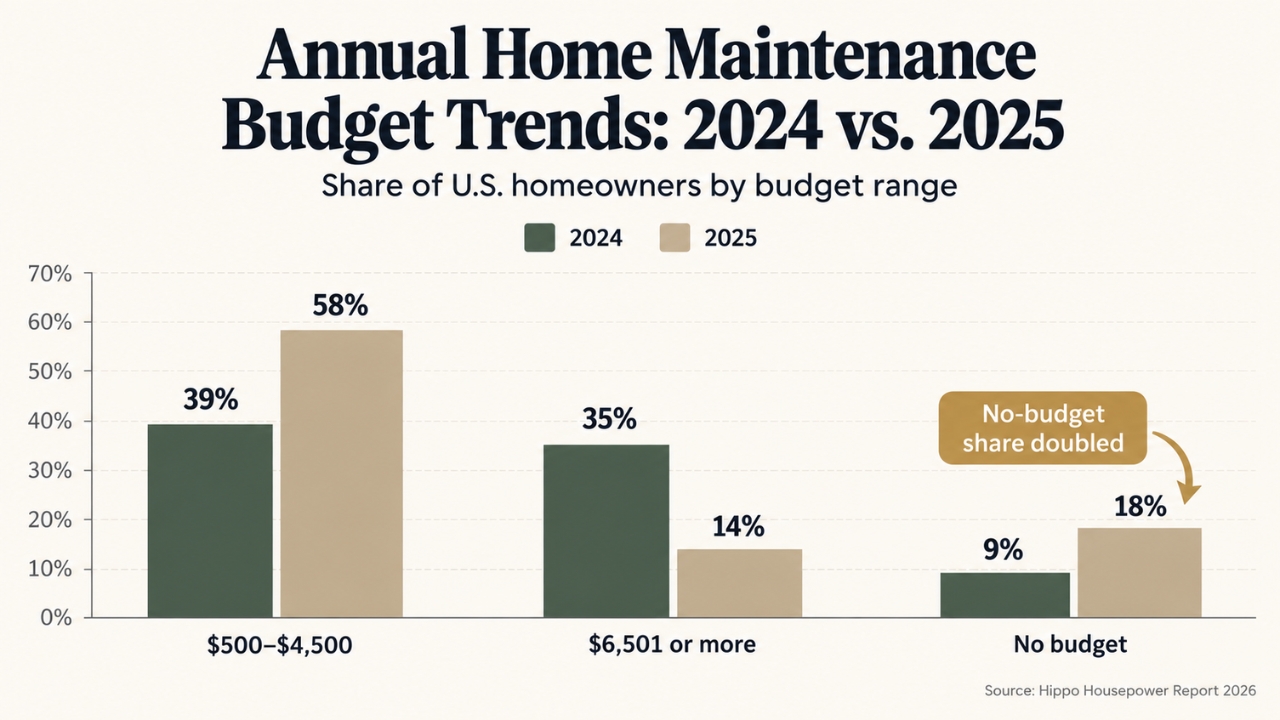
The collapse in the highest bracket, alongside the doubling of zero-budget responses, suggests that homeowners may be setting aside less money for work their houses will still require.
Hippo identifies financial pressure as one possible explanation; its survey does not establish individual motives.
Mortgage payments and property taxes compete with other essential bills. Home insurance premiums have become another serious source of strain, while homeowners in California may face additional costs associated with wildfire claims beyond their own policies.
Association charges add another fixed expense. In 2025, 43.6% of homes listed for sale carried HOA fees, with a median monthly fee of $135. The projected average winter home heating cost for 2026–27 reaches $1,030.
All these bills demand attention now. A roof that might need replacing in six years makes no such demand. Maintenance savings can therefore become the easiest category to erase from a spreadsheet.
That choice is dangerous. A missing line item changes the household’s accounting. It does nothing to change the building’s physical needs. Maintenance money can easily become ordinary spending. A household may discover it has already committed those funds elsewhere just when a major system needs replacing.
The Timing Is Particularly Bad
America’s owner-occupied housing stock is aging, making the retreat from maintenance planning particularly poorly timed.
According to a National Association of Home Builders analysis of Census Bureau figures, the median owner-occupied home was 42 years old in 2024. It was 31 years old in 2005. Approximately 47% of those homes were constructed before 1980.
View this post on Instagram
Condition varies by property. With more years in service, roofs, heating equipment, electrical systems, windows, plumbing, and water heaters approach replacement.
These components have different lifespans. An aging furnace and a deteriorating roof can require major expenditures within the same year, even after several uneventful years.
Research from Harvard’s Joint Center for Housing Studies provides useful context. For homes built before 1960, maintenance accounted for 22% of improvement and repair spending in 2023. For homes built in 2010 or later, the figure was 16%.
Those percentages measure spending composition and cannot establish an individual property’s annual maintenance bill.
The combination of aging homes and shrinking budgets should worry anyone concerned with the long-term condition of American housing. Buildings keep aging regardless of how much financial room their owners have left. Aging roofs, obsolete wiring, and poor drainage can complicate insurance or resale. Neglect may therefore create costs that reach beyond a contractor’s immediate invoice.
Unexpected Repairs Are Already Hurting Household Finances
The financial consequences are already visible in Hippo’s survey. In 2025, 33% of respondents said unexpected repair or maintenance expenses affected their financial stability. Across all categories of home-related problems, 76% reported at least one issue that had a financial impact.
These figures should be read alongside the 18% with no maintenance budget, without assuming the same households necessarily experienced every problem. They describe challenging repair bills alongside weakening financial planning.
Other research shows how quickly repairs take priority. In an Angi survey, home repairs outpaced renovations: 58% of homeowners reported repair projects, while 35% reported renovations.
When a critical repair arrives without money reserved for it, the household has to find another source. Possibilities include drawing down emergency savings, using a credit card, financing the work, postponing another home project, or leaving the defect unresolved.
Credit-card debt can create another expense beyond interest charges. In states that allow the practice, credit history can affect home insurance costs.
To preserve a low-rate first mortgage, some owners take a second home loan, adding debt service and risk to home equity.
The phrase “unexpected repair” obscures the predictable need for repairs throughout homeownership.
A maintenance budget exists precisely because the date of the next expensive failure cannot be placed on a calendar. Financing changes a repair’s total price. Interest and fees can stretch a single emergency into years of payments, leaving less income available when the next piece of equipment fails.
Deferred Maintenance Can Become Its Own Bill
A separate Hippo study, published in May 2026, found that 69% of homeowners had unfinished maintenance or repair work. Among respondents carrying that backlog, 45% estimated that catching up would cost at least $5,000. Another 15% estimated $20,000 or more.
Homeowners provided these estimates. The reported amounts suggest a substantial backlog.
Deferring a project sometimes makes sense. Interior painting, ornamental landscaping, and many cosmetic upgrades can be rescheduled with limited consequences for a property’s condition.
Moisture intrusion, failing plumbing, roof damage, unsafe electrical components, and drainage defects demand much closer attention. Delay can allow damage to spread into adjoining materials or essential systems, creating a larger repair scope.
Take an uneven floor. Ordinary squeaks can stem from minor movement in floorboards. Soft spots, pronounced sagging, or signs of moisture call for a more careful assessment. Our guide to squeaky floor repairs explains the differences homeowners should investigate.
Water damage illustrates the stakes even more clearly. A small recurring leak may eventually affect cabinets, flooring, drywall, and concealed framing. It can also create a mold problem. Whether home insurance covers mold depends on policy language and the circumstances that caused the damage.
Persistent leaks and visible deterioration are easy to normalize. Familiarity is a poor substitute for diagnosis. Professional inspections can help prioritize uncertain repairs.
A professional renovation or repair estimate may rise once hidden damage is discovered. Repair reserves should accommodate that possibility.
We would prioritize any defect threatening structural integrity, safety, or water resistance. Cosmetic work can wait its turn. Repeatedly postponing essential repairs risks converting a manageable expense into a much larger one.
The 1% Maintenance Rule Is Too Crude
The common guideline of saving 1% of home value annually for repairs creates false precision when applied universally.
Imagine two houses valued at $500,000. One is a newer, well-maintained 1,800-square-foot home with relatively recent equipment. The other is a 3,000-square-foot older property with a roof nearing replacement, aging plumbing, two heating and cooling systems, and substantial exterior upkeep.
Both carry the same market price. Their likely maintenance commitments could be very different.
Market values reflect location and demand, which bear little relationship to furnace replacements, siding repairs, or drainage work.
Budget around the building: list major systems, estimated remaining service lives, known defects, and local replacement costs.
Pay Particular Attention To
- Roof age, materials, and condition
- Heating and cooling systems
- Water heater and connected plumbing
- Supply and waste lines
- Electrical panels and wiring
- Foundation, grading, and drainage
- Windows, siding, and exterior finishes
- Major appliances and ventilation
- Trees, decks, driveways, and other site features
Multiple approaching replacements justify a larger reserve. Their timing and condition matter more than a simple percentage.
The 1% rule should never settle a homeowner’s savings target. Inspection reports, installation dates, maintenance records, and local contractor quotes provide a stronger foundation. Review that inventory every year, then adjust the reserve after major replacements or newly discovered defects.
Routine Maintenance and Repair Savings Are Different Things
Routine upkeep and reserves for major failures need separate budgets.
Routine upkeep includes HVAC servicing, gutter cleaning, filter replacement, inspections, and minor repairs. Budget for it annually.
Repair reserves address less predictable expenses such as an emergency plumbing repair or an early equipment replacement. They need to remain accessible when something important fails.
We would also keep these funds separate from renovation budgets. Optional improvements frequently exceed initial estimates. A kitchen upgrade should never be allowed to consume the only money available to fix a leaking roof.
Hippo reported that just 32% of surveyed homeowners had established an emergency fund specifically for home repairs. That is an uncomfortable figure beside the 33% who reported financial instability caused by unexpected repairs or maintenance.
40% of Americans spend most of their paycheck within 48 hours, a habit financial experts warn can hurt homeowners. Here’s how to build a home emergency fund from each paycheck: https://t.co/FRiuL4Pl6O https://t.co/1E9GLzdJmV
— Realtor.com (@realtordotcom) October 5, 2026
A reasonable savings target depends on income, labor costs, system ages, deductibles, and existing reserves.
A modest monthly transfer builds reserves. An inventory of upcoming replacements helps assess whether savings are adequate.
Our view is that even a modest, clearly defined maintenance plan is better than an impressive theoretical target that never becomes an actual savings balance. The first task is to make the expense visible. The next is to fund it.
The 18% Figure Says Something Bigger About Homeownership

Hippo’s Housepower survey was conducted by Centiment on September 22, 2025, using responses from 1,619 U.S. adult homeowners. The results were Census-balanced, and Hippo reported an overall margin of error of approximately two percentage points at a 95% confidence level.
This is survey evidence. It does not establish that precisely 18% of every homeowner population has zero savings. Having no dedicated maintenance budget also does not necessarily mean having no emergency money available. Those distinctions matter when interpreting the headline.
The trend still deserves attention. The survey recorded a doubling in the share reporting no maintenance budget, a steep decline in higher maintenance-budget brackets, and widespread financial pressure from home-related expenses.
Homebuyers typically scrutinize the purchase price, down payment, borrowing rate, and monthly mortgage cost. The long sequence of repairs and replacements receives much less disciplined attention, even though it can absorb substantial money over decades.
We think that imbalance is a serious mistake. The price of buying a home tells only part of the ownership-cost story. Every house contains components with finite service lives, and each of them will eventually require attention.
A maintenance reserve helps prevent predictable ownership expenses from becoming an avoidable household financial crisis.