

Home insurance costs increased 46% between 2021 and 2025, nearly three times the 16% rise in general inflation reported for the same period. According to Insurify’s 2026 insurance analysis, the average annual premium reached $2,948 at the end of 2025, following a 12% increase that year.
Insurify projected another 4% increase in 2026, bringing the annual figure to $3,057. That projection is an estimate, and actual premiums depend heavily on location, coverage, and property characteristics.
For perspective, a 46% increase would turn a $2,000 annual insurance bill into $2,920. That’s an additional $920 a year, or nearly $77 every month, for the same recurring expense.
We think insurance has become one of the most underestimated costs in the homeownership budget. Premiums can rise considerably while the house, mortgage balance, and household income remain largely unchanged.
And unlike many household expenses, maintaining homeowners insurance is generally a requirement for anyone carrying a mortgage.
Home Insurance Has Outpaced General Inflation
The recent increase is particularly significant because it follows several consecutive years of rising insurance costs.
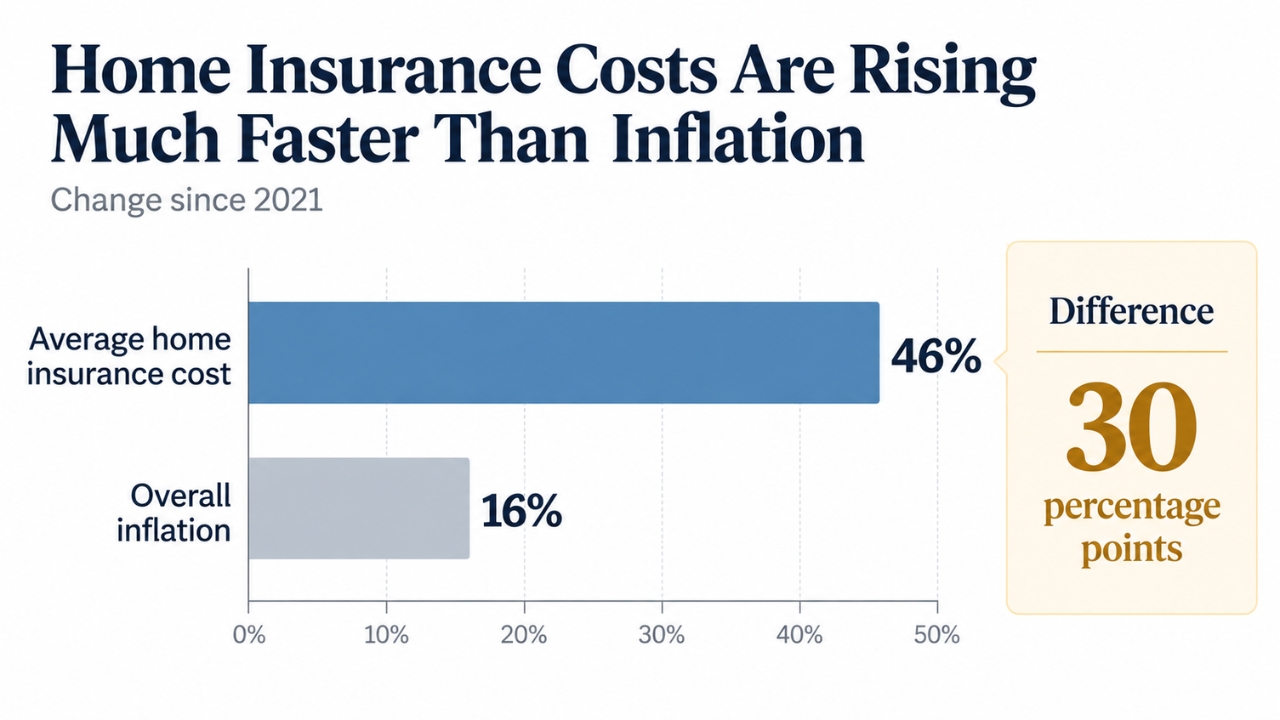
The National Association of Insurance Commissioners (NAIC) reported that the nationwide average premium for dwelling fire and owner-occupied homeowners policies increased 6.97% between 2020 and 2021. Its subsequent report documented another 10.5% increase between 2021 and 2022.
Insurify’s figures show that the upward pressure continued through 2025.
There is an important limitation to these comparisons. Insurify’s analysis uses insurance quotes and industry rate data to estimate premiums. Its state-level figures represent median prices under specified coverage and homeowner assumptions, including good credit and no claims during the previous five years.
The company also updated its methodology in 2026 to reflect changes in dwelling coverage values and storm-related deductibles.
Consequently, the reported $2,948 national figure should be treated as a market estimate. Individual homeowners may pay substantially different amounts.
Still, the direction of the trend is difficult to dispute. Home insurance has become more expensive, and the increases have been large enough to affect household budgets.
The troubling part is how little control an individual homeowner has over many of the underlying costs. A well-maintained house can face a substantial premium increase because insurers have suffered expensive losses across the surrounding region.
Why Home Insurance Has Become So Expensive

The insurance market has been dealing with several expensive developments at once.
Severe weather has generated substantial claims, rebuilding costs have increased, and insurers have faced pressure to reassess the risks associated with particular locations and types of property.
Reinsurance costs also matter. Reinsurance is coverage purchased by insurers to help manage particularly large losses. Those expenses influence the cost of providing homeowners policies.
When insurers expect claims to become more expensive, premiums generally need to reflect that exposure. Coverage restrictions, higher deductibles, and decisions to stop renewing certain policies can also become part of their response.
Disasters Are Producing Expensive Losses
The geographic distribution of disaster risk helps explain why insurance costs have become so uneven.
In January 2025, the U.S. Treasury Department published an analysis covering more than 246 million homeowners insurance policies from 2018 through 2022.
The findings were striking.
Homeowners in the 20% of ZIP codes with the highest expected losses from climate-related hazards paid an average annual premium of $2,321. That was 82% higher than the average in the lowest-risk 20% of ZIP codes.
The survey found homeowners living in areas most at risk of severe weather events paid an average annual premium of $2,321, 82 per cent higher than those who lived in areas least likely to be hit. https://t.co/og5VcMRrSU
— The Weather Network (@weathernetwork) January 18, 2025
According to the Treasury Department’s insurance analysis, claims were also more expensive in high-risk areas. Average claim severity reached approximately $24,000, compared with $19,000 in the lowest-risk locations.
Policy availability was another concern. Nonrenewal rates were approximately 80% higher in the areas facing the greatest expected losses.
Those differences have consequences for property ownership. Higher premiums increase annual housing costs, while limited insurance availability can make a property more difficult or expensive to finance.
California illustrates how disaster losses can affect homeowners throughout an insurance market. Residents may face additional charges related to wildfire claims even when their own properties have suffered no damage.
Hail and severe thunderstorms deserve similar attention. These events can damage thousands of roofs within a relatively short period, producing enormous claims across entire regions.
The insurance industry has to account for those losses. Homeowners ultimately encounter the financial consequences through renewal prices and coverage conditions.
Rebuilding a House Costs More
A home’s rebuilding cost is one of the most important factors in determining appropriate dwelling insurance coverage.
Rebuilding cost refers to the expense of reconstructing the insured structure after a covered loss. It depends on construction materials, labor, local building requirements, and the work needed to restore the property.
Market value follows a different calculation. A house worth $450,000 might have a substantially higher or lower rebuilding estimate because its sale price also reflects land value, location, and housing demand.
This distinction has become increasingly relevant as construction expenses have risen.
The Bureau of Labor Statistics documented substantial price increases across several categories of construction materials, including lumber, steel, and roofing-related products, during the early part of the decade.
Local labor shortages, building-code requirements, demolition, and debris removal can create additional expenses after a major loss.
Consider an illustrative roof replacement that previously cost $15,000 and now costs $22,000. That represents an additional $7,000 for one repair. Across thousands of storm-damaged properties, increases of that magnitude can have a substantial effect on insurance claims.
Rising rebuilding costs create another problem for homeowners: inadequate dwelling coverage.
A policy based on an outdated rebuilding estimate may leave a large financial gap after a serious loss. Homeowners should periodically review their coverage limits, particularly following major changes in local construction costs.
Where You Live Matters More Than the National Average
A national insurance estimate becomes considerably less useful when comparing individual housing markets.
Insurify’s 2025 figures show just how substantial the differences can be.
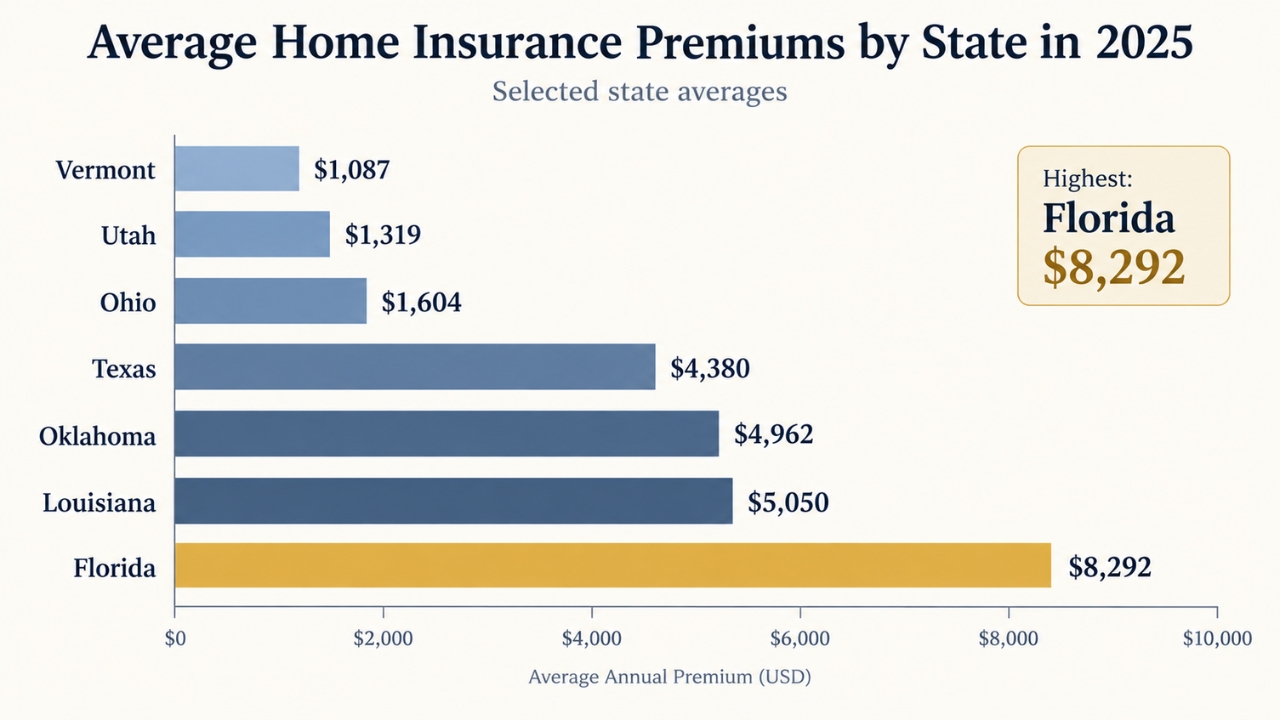
The estimated annual difference between Florida and Vermont exceeds $7,200, equivalent to approximately $600 per month.
That is a substantial difference in the recurring expense of owning a home.
The comparison also requires some caution. Insurify uses typical dwelling coverage amounts that vary by state, so these figures do not represent identical homes insured for identical amounts.
They remain useful for illustrating the enormous influence of geography.
High premiums extend well beyond states exposed to hurricanes. Oklahoma, Nebraska, and Minnesota illustrate the financial significance of hail, wind, and other severe storms.
Some of the largest increases during 2025 occurred in the Midwest and Great Plains. Insurify reported premium increases of 34% in Minnesota, 33% in Colorado, 28% in Iowa, 25% in Nebraska, and 24% in Oklahoma.
We would be cautious about using any national average to estimate the insurance cost of a specific house.
Even within the same ZIP code, roof age, construction materials, property condition, prior claims, deductible choices, and, where permitted, credit history can produce different quotes.
For buyers comparing properties, an actual insurance quote offers far more useful information than a generalized estimate.
Rising Insurance Costs Are Starting to Change Household Decisions
The financial pressure is already influencing whether homeowners maintain adequate coverage.
The Federal Reserve’s 2026 report on household finances, based on 2025 survey responses, found that 6% of homeowners went without homeowners insurance.
View this post on Instagram
The rate was considerably higher among homeowners without a mortgage. Approximately 13% of people who owned their homes outright were uninsured, compared with 3% of homeowners carrying a mortgage.
Cost was a major factor. Among uninsured homeowners, 43% said they could not afford coverage.
The survey also revealed financial pressure among those who maintained insurance:
- 20% wanted additional coverage but could not afford it.
- 14% reported struggling to afford their premiums.
- More than 60% said their insurance costs had increased more than expected in recent years.
These figures raise an important question about the financial protection homeowners are actually receiving.
Higher premiums can encourage households to increase deductibles or reduce certain types of coverage. Those decisions may lower the annual bill, while increasing the amount the homeowner could owe after a covered loss.
We consider that tradeoff one of the most serious consequences of rising insurance costs.
For a household with limited savings, a large deductible can create the same immediate financial problem the insurance policy was supposed to help manage.
Read the Policy Before Celebrating a Lower Premium

Comparing insurance quotes remains a sensible response to a significant premium increase. The NAIC recommends comparing insurers and coverage options to understand available prices and protection.
The details of the policies deserve as much attention as the annual premiums.
Several features are particularly important:
- Dwelling coverage: The amount available to repair or rebuild the insured structure, subject to policy terms.
- Deductibles: The portion of a covered loss the homeowner must bear.
- Wind and hurricane deductibles: Separate deductibles that may be calculated as a percentage of the insured dwelling amount.
- Roof coverage: Whether the policy pays replacement cost or accounts for depreciation.
- Coverage exclusions: Types of damage or circumstances that the policy does not cover.
- Additional living expenses: Coverage that may help pay temporary living costs when a covered loss makes the home uninhabitable.
Percentage-based deductibles can be especially expensive.
For example, a 5% hurricane deductible on a dwelling insured for $300,000 equals $15,000. A homeowner facing a covered hurricane loss subject to that deductible would be responsible for the first $15,000 of covered damage before the insurer’s payment calculation applies.
Roof coverage creates another potential financial exposure.
The NAIC explains the distinction between actual cash value and replacement cost. Actual cash value generally accounts for depreciation, which can significantly reduce the payment for an older roof.
A policy that costs several hundred dollars less annually may therefore leave the homeowner facing thousands of dollars in additional expenses after a claim.
Coverage exclusions can be equally important. As our discussion of home insurance coverage for mold explains, the cause of damage often determines whether a claim qualifies for payment.
Homeowners should know the deductible they can realistically afford and understand how their policy would respond to the kinds of losses most likely to affect their property.
Insurance Should Be Part of the Home-Buying Budget
@brandpropertiesgroup 🏡 Homeowners insurance is an important part of your homebuying budget, and it is one expense buyers don’t want to overlook. Premiums are still rising, but recent data shows the pace of those increases is beginning to slow. Because insurance costs can vary based on the home, its location, coverage, and upgrades, getting quotes early can help you understand the full cost of owning a home before you commit. In this video, Suzie shares a few ways buyers can prepare, including comparing insurance companies, asking about discounts, bundling home and auto policies, and making sure improvements such as a new roof are considered. Ready to begin your home search? Suzie and Brand Properties Group would love to help! 📞 (972) 539-6555 📧 [email protected] #brandpropertiesgroup #kellerwilliams #kellerwilliamsrealty #gonetwork #homebuyingtips @Stacey Sauer @Suzie Burress ♬ Open – Teesa
Homebuyers frequently use mortgage calculators to estimate their monthly housing costs. The accuracy of those calculations depends on the assumptions entered.
Insurance deserves particular attention because a generic estimate can create a substantial budgeting error.
Consider two properties with similar mortgage payments. One requires $2,000 in annual insurance premiums, while the other costs $6,000.
The second property adds $4,000 per year, or approximately $333 per month, to the household’s ownership expenses.
Over five years, that difference amounts to $20,000, assuming premiums remain unchanged.
That money could otherwise support emergency savings, maintenance, or other household priorities.
Insurance also belongs alongside the other recurring and unpredictable expenses associated with ownership.
For example, properties with homeowners association fees carry another ongoing financial obligation. Meanwhile, unexpected repairs can delay planned projects and force households to redirect money from other priorities.
Utilities add another layer of uncertainty. Our reporting on winter home heating costs examined a forecast national average of $1,030 for the 2026–27 winter, an 8.7% increase.
Maintenance planning is another persistent weakness in household budgets. A recent survey found that the share of homeowners with no home maintenance budget had doubled to 18%.
Adding these obligations together can substantially change the affordability of a property.
We think property-specific insurance quotes should be obtained early in the buying process, preferably before a buyer makes a major financial commitment.
Where possible, buyers should also investigate the property’s insurance history, roof age, major risk exposures, and available coverage options.
A house that looks affordable using an assumed $200 monthly insurance payment may produce a very different calculation when the actual quote arrives at $500.
A 46% Increase Changes the Economics of Homeownership

Rising insurance premiums are part of a broader change in the cost of owning residential property.
Homeowners face recurring obligations that can increase independently of their mortgage principal and interest payments. Insurance, property taxes, utilities, and maintenance all influence the long-term financial burden.
Repair expenses are particularly relevant. Our analysis of the difference between home repairs and renovations found that 58% of surveyed homeowners had paid for repairs, compared with 35% who had undertaken renovations.
These obligations help explain why the purchase price provides an incomplete picture of affordability.
In a July 2025 Federal Reserve speech on housing affordability, Governor Adriana Kugler cited research showing that the cost of owning a home relative to median income reached its highest level since 1980 in 2023. The calculation accounted for home prices, mortgage rates, property taxes, and homeowners insurance.
The 46% insurance increase illustrates how quickly one component of that burden can change.
For current homeowners, reviewing coverage limits, deductibles, and competing quotes should be a regular financial exercise. For buyers, insurance needs to be priced for the actual property before deciding what they can afford.
A realistic homeownership budget needs to account for the expenses that continue changing long after closing. Insurance has earned a much more prominent place in that calculation.